Case study · Founder & solo builder · Mar 2026 – present
CityRuleLookup
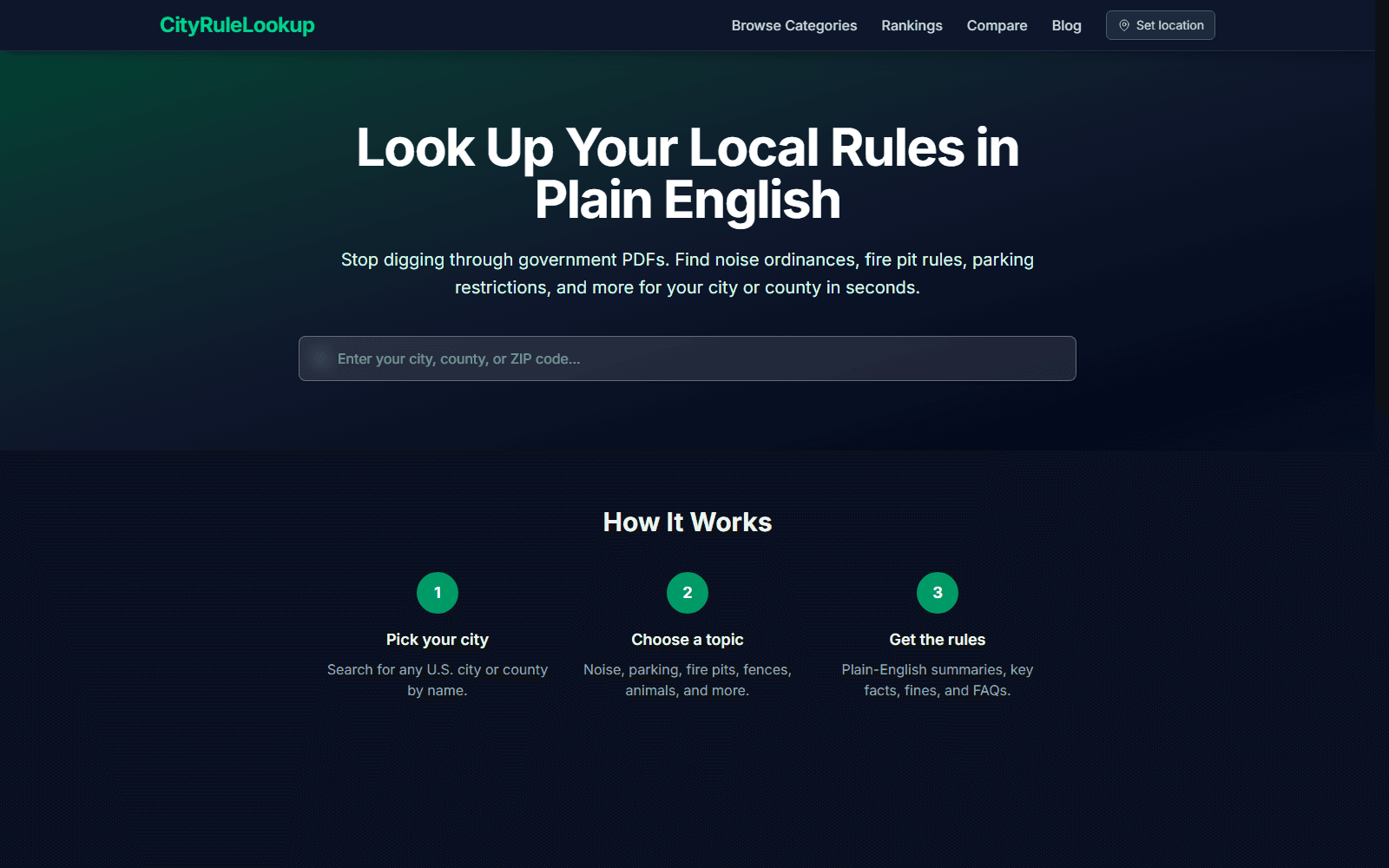
A plain-English answer to “what are the rules where I live?” — noise, parking, fences, fire pits, short-term rentals, ADUs — for 5,800+ U.S. cities and counties, born from my own DIY builds. Founded March 2026. More than 50K monthly users within five months, built end-to-end by one person and a fleet of AI agents.
>50K
monthly users in the first five months
115K+
plain-English rule summaries
5,800+
U.S. cities & counties covered
<30 days
from first commit to launch
Born in my backyard
CityRuleLookup exists because I love to build things myself. Over the years I've built a deck, put up gazebos, torn interior walls down to the studs, redone flooring, and built fences and retaining walls — and every one of those projects starts the same way: not with a saw, but with a question. Does the deck need a permit? How tall can the fence be? How close to the property line can a retaining wall sit?
Getting those answers meant digging through municipal-code portals and scanned PDFs written for lawyers, not residents — when the answers could be found at all. Nobody wants to read Chapter 9.44.010; they want to know whether they can pour footings on Saturday. That gap — between how often people need their local rules and how hard the answers are to reach — is the reason the platform exists.
CityRuleLookup closes it: plain-English answers for noise, parking, fences, fire pits, short-term rentals, ADUs and more, with every claim linked back to the official source — falling back from city to county to state rules so no page is ever an empty shell.
Run like a product org, staffed by AI agents
Covering 5,800+ jurisdictions across 58 rule categories is not a job one person can research by hand. It became a management problem instead: I run the product the way I ran teams at Imgur, except the team is a fleet of AI agents — Claude Code in the lead, with local models running through Ollama picking up research tasks — and the specs, QA gates, and retros are all written down for them.
The repo tells the story on its own: 555 commits in five months, 60% of them pair-programmed with Claude, and thousands of agent-produced research batches, with validation gates standing between agent output and anything that ships.
Playbooks over prompts
Every workflow lives as a written spec that a brand-new AI session can execute cold: research protocols, style guides, seeding checklists, and resume points. The documentation is the management layer.
Parallel agent fleets
Research and content generation fan out to as many as 20 concurrent agents — Claude alongside local Ollama models — each owning a bucket of work. That's how all 50 states went from zero to full baseline coverage in four days.
Prioritization by expected value
Coverage gaps are scored by population and search value, then filled in ranked batches — the same way a product team runs a backlog, except the sprint team is a fleet of agents.
Verification as a gate, not a hope
Claims must trace to an official source or they don't ship. Mechanical pre-publish checks, independent audit agents, and a verify-then-notify gate stand between generated content and search engines.
555 commits · up to 20 concurrent agents · 50 states seeded in 4 days
Trust is the product
A site that tells people what the law says has exactly one asset: being right. That rule shaped the whole pipeline. Every rule links to the official municipal code, and when a city-specific claim can't be verified against a primary source, the site inherits verified county- or state-level data instead of guessing.
Around the content itself sits a trust loop: named authorship, a public editorial process, a reader correction flow, and a recent-changes feed. Generated content passes mechanical pre-publish checks and independent audit agents before search engines are ever notified it exists.
Five months, fast
Feb 2026
From empty repo to launched product
Scaffolded the site, seeded the first Southern California cities by hand, and went live on March 1 — ads and sitemaps included. Claude Code was in the loop from the earliest days.
Mar–Apr 2026
Industrializing the content pipeline
Scaled from hand-seeded cities to written playbooks executed by parallel AI agents: hundreds of counties, then baseline coverage for all 50 states — researched, generated, validated, and seeded in four days.
May 2026
Early traction, then a reshuffle
The first two weeks of May brought 184K Google impressions and 3.4K clicks at an average position of ~10. Then a Google core update reshuffled rankings across the web, and the three-month-old site's Google traffic fell to a trickle.
May–Jun 2026
The distribution pivot
Adopted IndexNow so Bing and other engines index changes in minutes, invested in reader trust — named authorship, a public editorial process, a reader correction flow — and optimized for the engines that were listening. Bing clicks grew roughly 10× in two months.
Jul 2026
Quality, scale, and a one-day migration
Ran a site-wide verification campaign over the entire catalog, expanded coverage past 115K rule summaries, and migrated hosting from Vercel to Cloudflare Workers — OpenNext, R2-backed ISR cache, Durable Objects — in a single day.
Growing without Google
The remarkable part of >50K monthly users isn't the number — it's where they come from. After the May core update, the audience was rebuilt almost entirely on Bing, Yahoo, and DuckDuckGo, with a fast-growing long tail of referrals from AI assistants like ChatGPT and Copilot. Google — which typically sends more search traffic than every other engine combined — currently accounts for roughly 6% of users.
Direct traffic excluded. AI assistants = ChatGPT + Copilot referrals. GA4, Apr–Jul 2026. Google is the channel still on the table.
That's the asymmetry the next two quarters are about. The audience was built while the largest search engine was barely contributing. If Google rankings recover to even their early-May trajectory, search traffic could roughly double — without shipping a single new page.
The numbers
>50K
monthly users (past 30 days)
93K
users in the past 90 days
10×
Bing click growth, Apr → Jun
~52s
average engagement time
50
states with full baseline coverage
1.3K+
ChatGPT & Copilot referrals
Under the hood
- Frontend
- Next.js 16 (App Router, ISR), React 19, Tailwind CSS v4
- Data
- Supabase (Postgres) — 115K+ rule summaries with a three-tier city → county → state fallback, so no page is ever empty
- Infrastructure
- Cloudflare Workers via OpenNext — R2-backed ISR cache, Durable Object revalidation queue; migrated from Vercel in one day
- Content pipeline
- Claude API + parallel agent fleets, local LLMs via Ollama for research tasks, mechanical validation gates, IndexNow for instant re-indexing
- Analytics
- GA4 + PostHog, with a custom server-side insights dashboard on an admin subdomain
- Monetization
- Google AdSense
See it live
Look up your own city — or get in touch if you want to talk about product, AI-agent workflows, or what it takes to ship this fast.